Safety
What we can do, and what we cannot
Relationship software touches people at their worst moments. That deserves a straight answer about our limits, not reassuring copy.
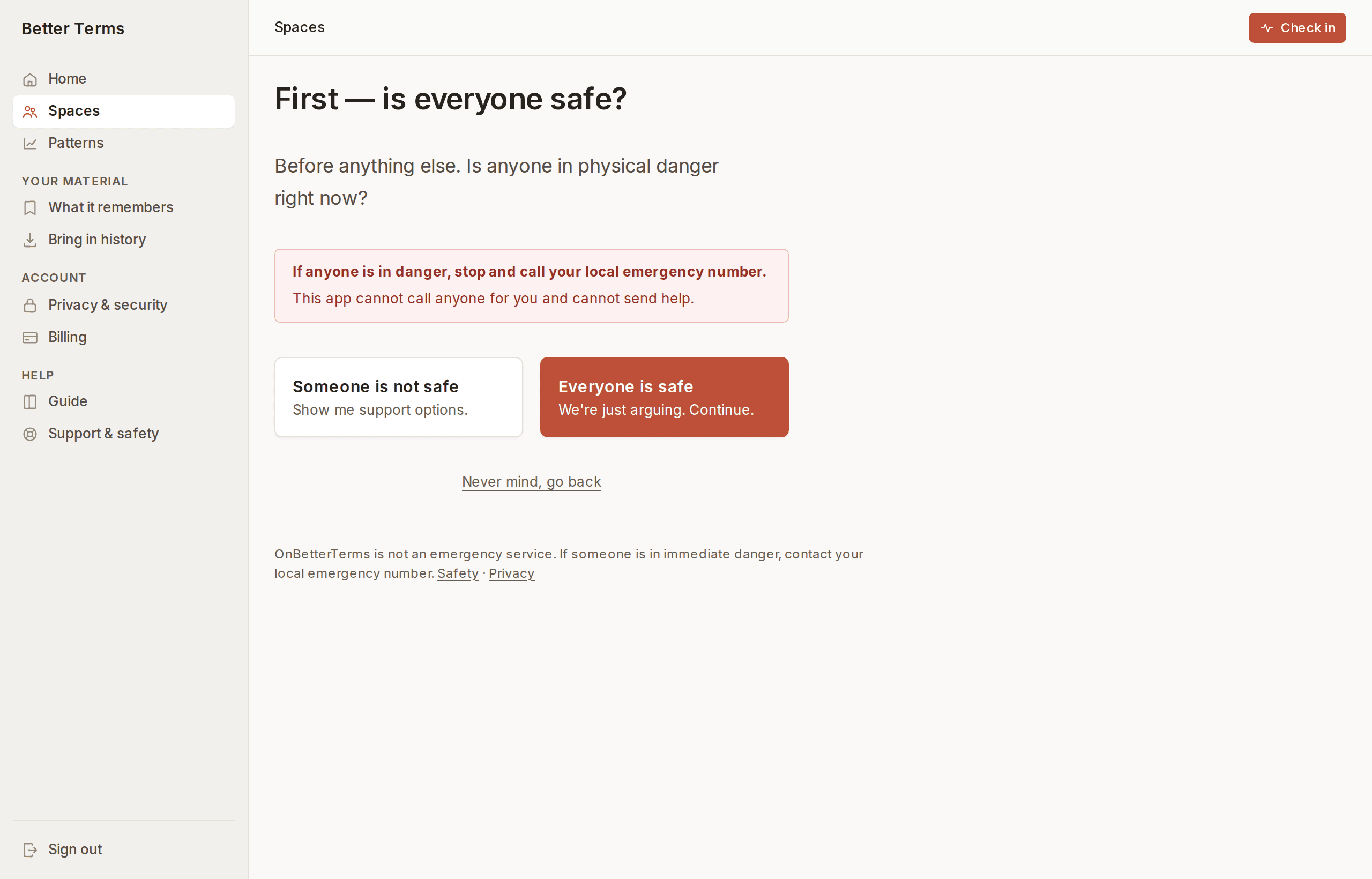
If someone is in danger right now
Contact your local emergency number. OnBetterTerms is not an emergency service, cannot dispatch help, and may not see what you write for some time. Please do not rely on this app in an emergency.
What we cannot do
Stated first, because these are the limits that matter:
- We do not contact the police or emergency services. We do not have verified identity, your location, or any jurisdiction to act in. AI has limits, and we would rather you knew exactly where ours are.
- We cannot guarantee we will notice. Detection is imperfect in both directions.
- We are not a crisis line. There is no one waiting to respond in real time.
- We are not clinicians. No diagnosis, no treatment, no clinical judgement.
- We cannot make anyone safe. Software does not do that.
What we actually do
When something you write suggests a serious risk, the app stops behaving like a communication coach. Depending on how serious it looks:
- we show crisis and support resources — the ones for your country where we have verified them ourselves, and an international directory of helplines everywhere else. We do not show a number we have not checked is real and current
- we stop offering relationship advice, which is the wrong tool
- we suggest reaching someone you trust, if that is safe for you
- in a small number of the most serious cases, a reviewer on our team may read the relevant entry
How we decide, and why it is not keyword matching
“I could kill him for leaving the dishes out” and “I'm driving to his house right now and I have my gun” share vocabulary and share nothing else. A system that reacts to words will either flood you with false alarms or miss the real thing.
So instead of matching words, we assess structure: is there stated intent, a specific plan, access to means, a timeframe, a specific person, immediacy, whether it has come up repeatedly, and whether it should be read literally at all. Severity follows from those answers through fixed, reviewable rules rather than a model's freehand judgement — and when the assessment is uncertain, it does not escalate.
We take false alarms seriously as a harm in their own right. A product that overreacts teaches people to write less honestly, and someone hiding things from their own private journal is the outcome that actually gets people hurt.
If the relationship itself is the danger
Ordinary couples-communication advice — compromise, patience, see it from their side — is actively dangerous when one person is being controlled or hurt. So when signs of abuse, coercive control, stalking or sexual coercion appear, the app changes what it does:
- it stops suggesting joint sessions and compromise
- it never suggests confronting someone when that may be unsafe
- it does not frame violence as a two-sided problem
- it never notifies the other person — not that a concern was raised, not that anything changed
- anything you write about planning or leaving stays private from them
That last pair matters most. If the person you share a space with is the risk, a notification is not a safety feature — it is a danger. Nothing in our safety system produces any signal the other person can observe.
The privacy limit
Content marked never shared is private from the other person in your space. That does not change. It is not a promise of immunity from lawful process, and in the small number of serious cases described above a reviewer on our team may read the relevant entry. We tell you this before you first use that level, and again on the privacy page.
Access to safety records
Reaching a safety record requires a specific role that ordinary support and analytics accounts do not have, and the system writes an audit entry before the content is decrypted rather than after — so an access that happened cannot fail to be recorded. A reviewer opens one case at a time; there is no screen that lists the content of the queue. The other person in your space can never see any of it.
Those are properties of the software, and they are true today. The surrounding commitments — who holds the role, what training they have had, how often the audit log is read and by whom — are operational, and we will publish them here as specific facts rather than as adjectives when the answer is a person rather than a plan.
Concerns about how we handle this: support@onbetterterms.com. The formal version is the safety policy.