How it works
Start alone. Add someone when you are ready.
OnBetterTerms is built so the first half is useful on its own. Nothing here needs the other person to be enthusiastic, or even involved.
The whole sequence
Three of these are optional, and the page says which. You can stop after any of them and still be using the product properly.
Create your private account
Yours alone. Nothing is connected to anyone, and nothing is shared until you decide it is. If you never invite a second person, the private half still works — notes, check-ins, your own guide, your own patterns.
Bring your history, if you have someOptional
Export your conversations from ChatGPT, Claude, Gemini or Grok and choose what comes with you. You see everything in the file before a word of it is written, and it arrives private.
There is no option to import into a space someone else can read.
Invite the other person, if you want toOptional
A link, a QR code, an email, or a short code you can read out. They have to accept before anything connects, and accepting never gives them access to anything you wrote before they joined.
Check in during the day
One number, one tap. Add a sentence if you feel like it, or say it out loud instead of typing. You pick the privacy level before it saves, and you can check in as many times a day as you want — a bad hour is data too.
Talk to your own guide
It has your history, so you are not re-explaining yourself every time. It helps you work out what you actually mean, separate what happened from what you think it meant, and find words you could really say out loud.
Rate a reply and the next one changes — shorter, blunter, more options, fewer questions.
Work through something togetherOptional
When you both choose to. A shared session is built only from what you have both marked shared, so your private notes are not in the room. It slows things down, takes one issue at a time, and does not pick a winner.
Say how it went
Afterwards, separately: did that feel resolved, did you feel heard, what do you want to remember. Short, private, and the thing that makes the next round of guidance better rather than just longer.
Notice what keeps happening
Over weeks the check-ins become something neither of you could reconstruct from memory: what keeps coming up, what is improving, which evenings are hard. Observations, hedged honestly, never predictions about your future.
The whole thing, once through
Forty-five seconds, start to finish.
One disagreement, from writing it down on your own to saying how it went afterwards. No sound, nothing to sit through twice.
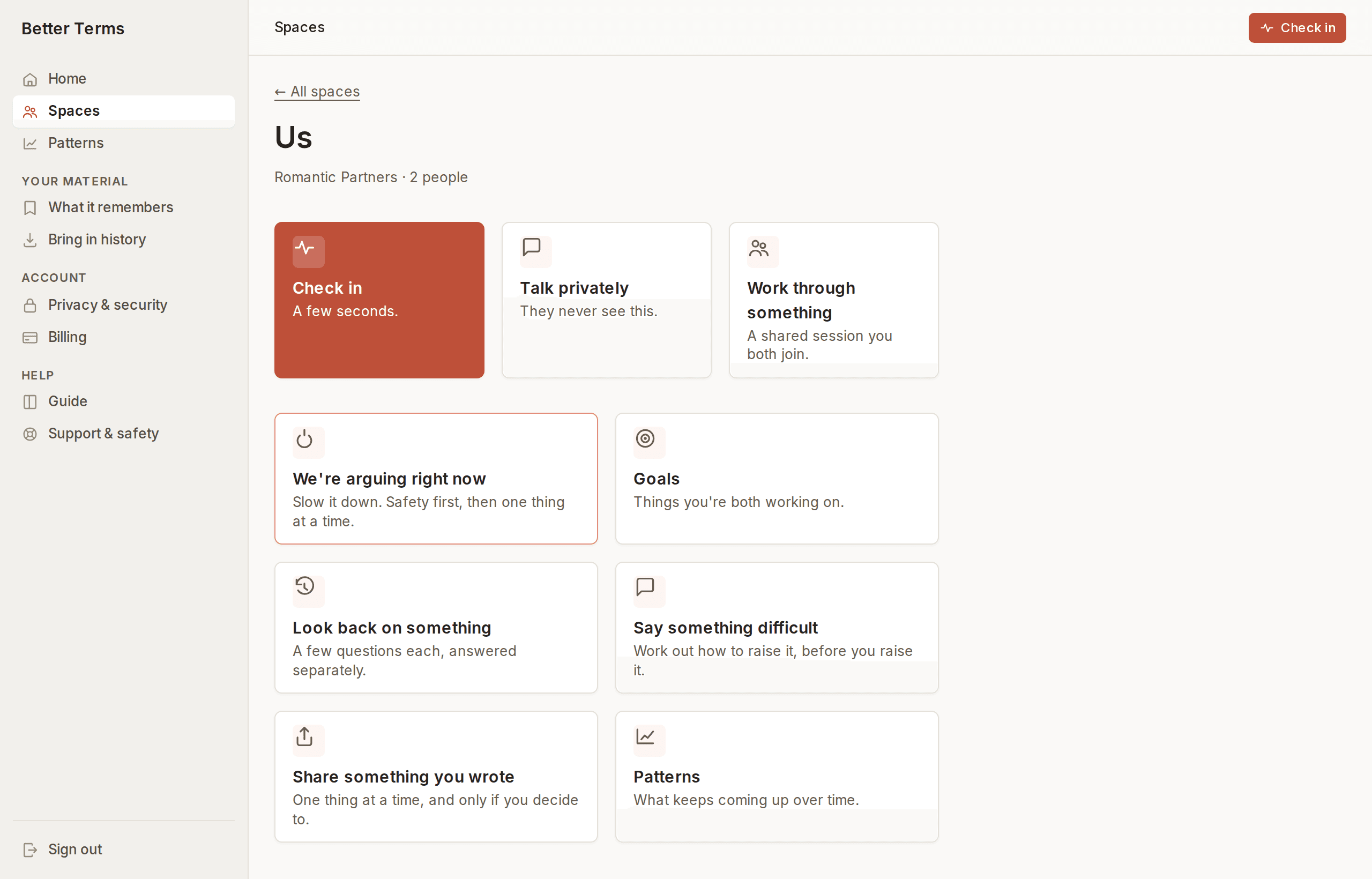
- Start with your own side of itA check-in, with the privacy level chosen before anything is written.
- Talk it through privatelyYour own guide, working from your history rather than from nothing.
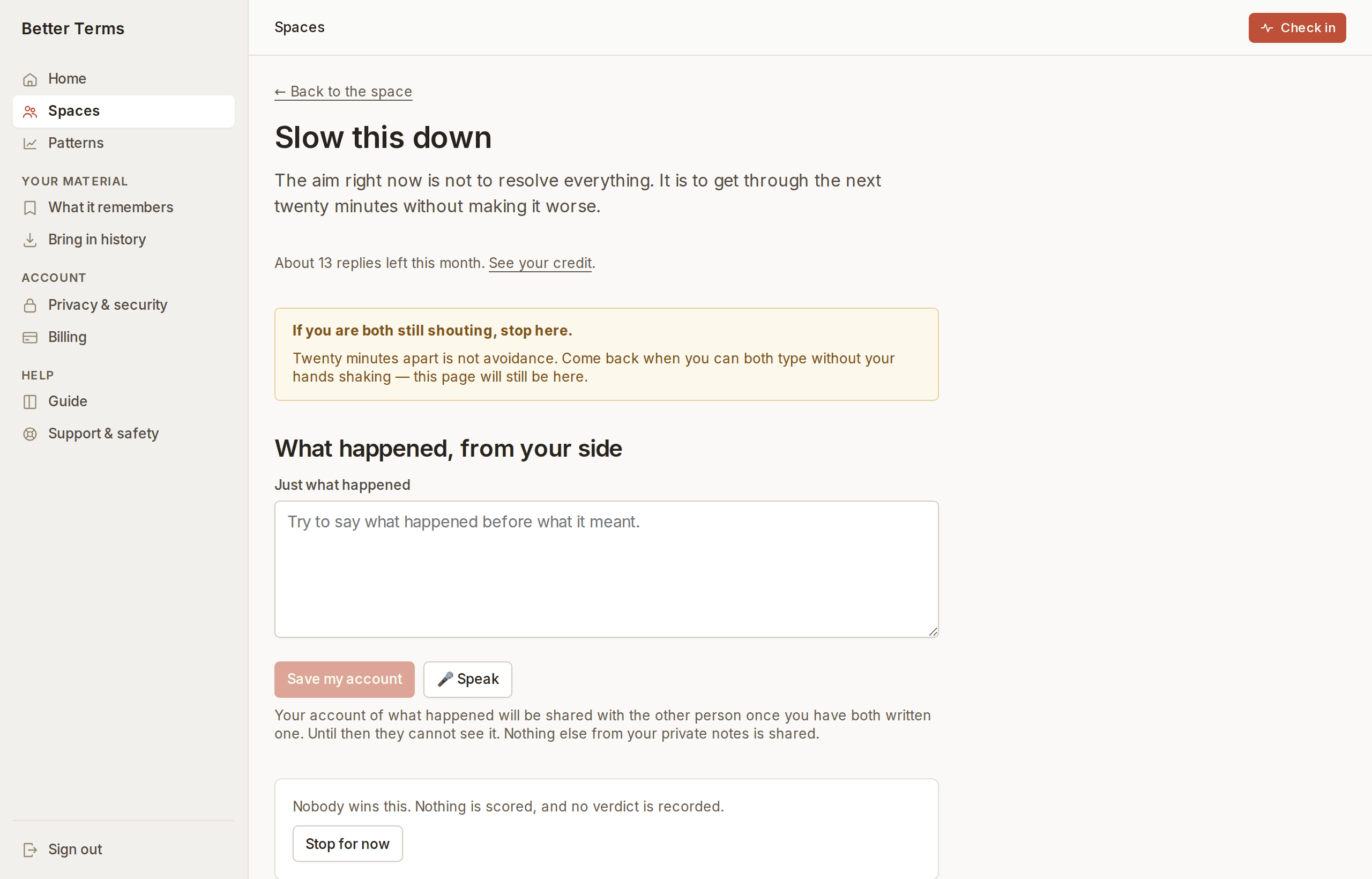
- Together, when you are readyDe-escalation asks whether everyone is safe before it asks anything else.
- You each write your own accountYours is saved and theirs stays hidden until they have written it.
- Then both, at onceNeither version had a chance to be written around the other.
- Agreement surfaces when it is mutualMark what you agree with; they never see a mark they did not also make.
- What tonight will not settle is parkedParked is not dropped — it stays on the record to come back to.
- Afterwards, separatelyEach of you says how it went, where the other cannot read it.
Bring your context
You have explained this before. Don’t start over.
Every new chat begins from nothing — who everyone is, what happened in March, what you have already tried. If you have spent months explaining that to ChatGPT, Claude, Gemini or Grok, export it and bring the parts that matter.
- See every conversation in the file before anything is written.
- Choose them one at a time, or by date. Nothing is all-or-nothing.
- It arrives private, and there is no option to import into a space someone else can read.
- Changed your mind? Undo removes everything that import created.
- It is left out of your patterns — six years of conversations with another product is not six years of this one.
Reads exported files from ChatGPT, Claude, Gemini and Grok, this product’s own export, or plain text — and an unfamiliar export by its shape. Nothing is connected to your accounts, and no credentials are asked for.
| Conversation | Messages | Started | |
|---|---|---|---|
| Money conversation prep | 42 | Mar 2026 | |
| Talking to my sister | 18 | Feb 2026 | |
| Rewriting my CV | 96 | Feb 2026 | |
| Holiday planning row | 11 | Jan 2026 |
Independent Perspectives
Two perspectives. Neither gets to rewrite the other.
Both accounts are written before either is read. Not as etiquette — the product will not show you theirs until yours is in, because the moment you read their version, your own quietly reorganises itself around it.
You write yours first
They write theirs, unread
Then both, at once
- You agree the date matters and that neither of you wants to cancel.
- You disagree about what was said, not about what either of you wanted.
- One thing to settle first: how plans get confirmed, not this plan.
You don’t need to agree on what happened to agree on what happens next.
Two people can remember the same evening differently without either of them lying. Most arguments are that, and treating it as a dispute about facts is what makes them last. Nothing here scores, tallies or declares an outcome — not as a rule the model is asked to follow, but because a verdict would just become the next thing to argue about.
Check-ins
21
Your average
6.8/ 10
Direction
Trending upSunday evenings score lowest, and have done for six weeks.
Private check-ins
A number and a sentence, when you have ten seconds.
Over weeks this is what turns into something useful: which days are harder, what tends to come before a bad stretch, what has actually improved.
Private unless you say otherwise, and below eight check-ins it says there is not enough yet rather than drawing a line. A trend through three points is a picture of nothing.
What holds at every step
Shared, private, or never shared. Chosen while you write, not in a settings page you visited once.
Somebody who accepts an invitation today cannot read what you wrote yesterday.
No agency, employer or service is contacted on your behalf. This is not an emergency service.
Export everything you can see, or delete the account and the key that makes its contents readable.
Step one takes about a minute.
Free, no card, and nobody is notified that you signed up.