Features
Everything it does, and what each part is for.
Grouped by who it is for: you alone, a space you share, and what accumulates over time. Anything not built yet is not listed here.
For you, privately
Your own AI guide
Reads what you have written and how you like to be spoken to. Helps you organise your thoughts, prepare for a hard conversation, and find words you could actually say. Never speaking to the other person.
Private journal
Write or speak. Every entry carries a privacy level you choose before saving.
The never shared level
The strongest level. Never shown, quoted, summarised, counted, hinted at, or exported to the other person — and no notification is sent when you write in it. Your own guide can still use it to understand you.
Voice input everywhere
Tap the microphone and talk. You see the transcript, edit it if it got something wrong, then choose the privacy level. Audio is deleted after transcription by default.
Personalization you control
Rate any response. The guide learns whether you want direct or gentle, short or thorough, validation or solutions. This stays private — the other person is never told how you prefer to be spoken to.
Nothing kept between sessions
A conversation with your guide lives only while it is open. It ends when you end it, after thirty minutes of silence, or after eight hours — and nothing is extracted from it to carry into the next one. There is no list of what it decided about you, because there is nothing to list.
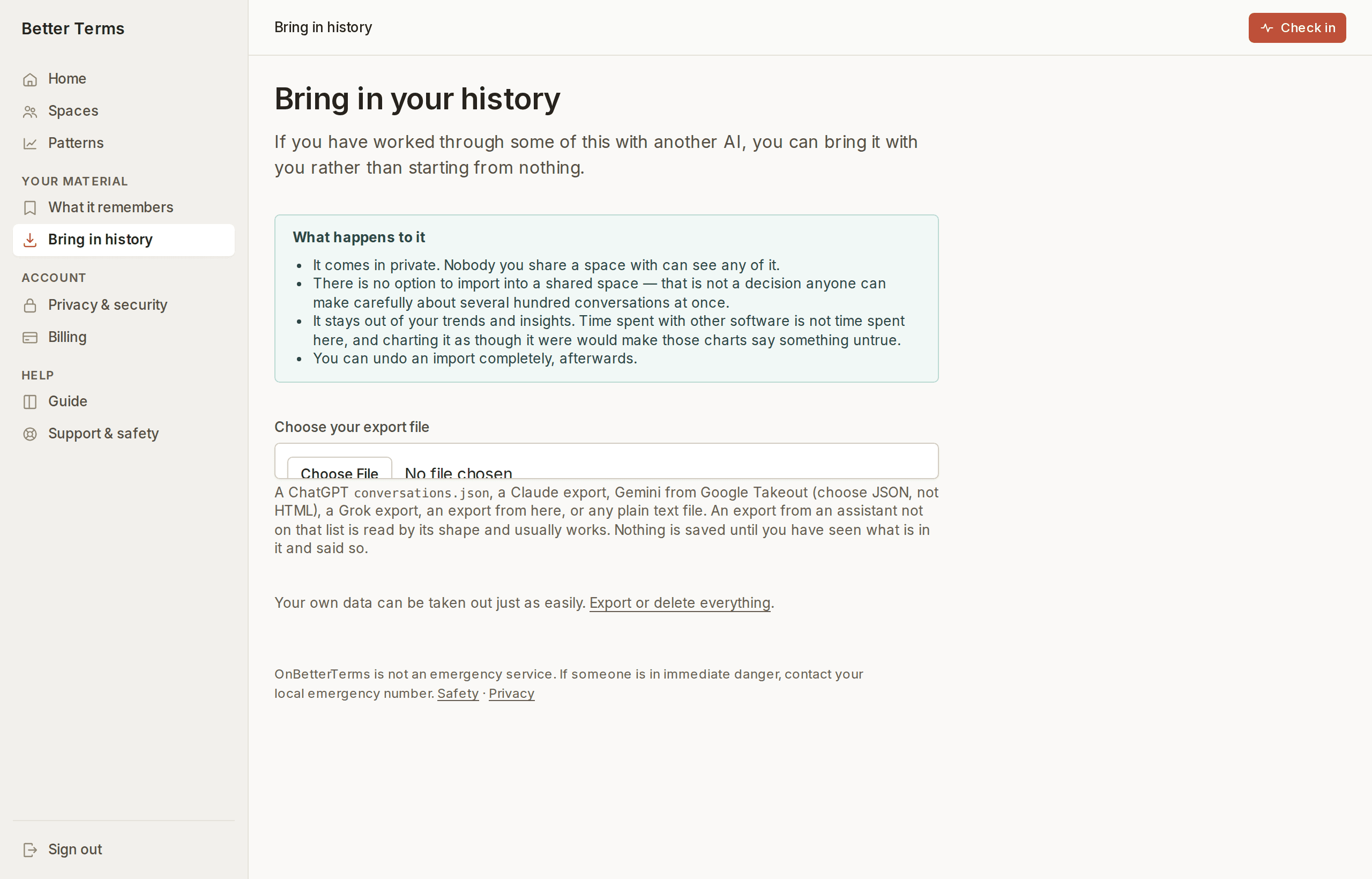
Bring your history with you
Import what you have already written elsewhere: ChatGPT, Claude, Gemini through Google Takeout, Grok, and exports from other assistants, which are read by their shape. You see every conversation in the file first and choose what comes — one at a time or by date. It arrives private, is marked as imported so it is never mistaken for what happened here, is left out of your patterns, and an undo removes everything that import created.
For a space you share
Shared mediation
A structured conversation you both opt into. Summarises each position until you each agree it is right, finds the points you already agree on, splits a big argument into the smaller ones it is made of, and takes them one at a time.
De-escalation mode
For when you are arguing right now. Checks safety first, slows the pace, lets each of you explain separately before showing the other version, and parks what cannot be resolved tonight.
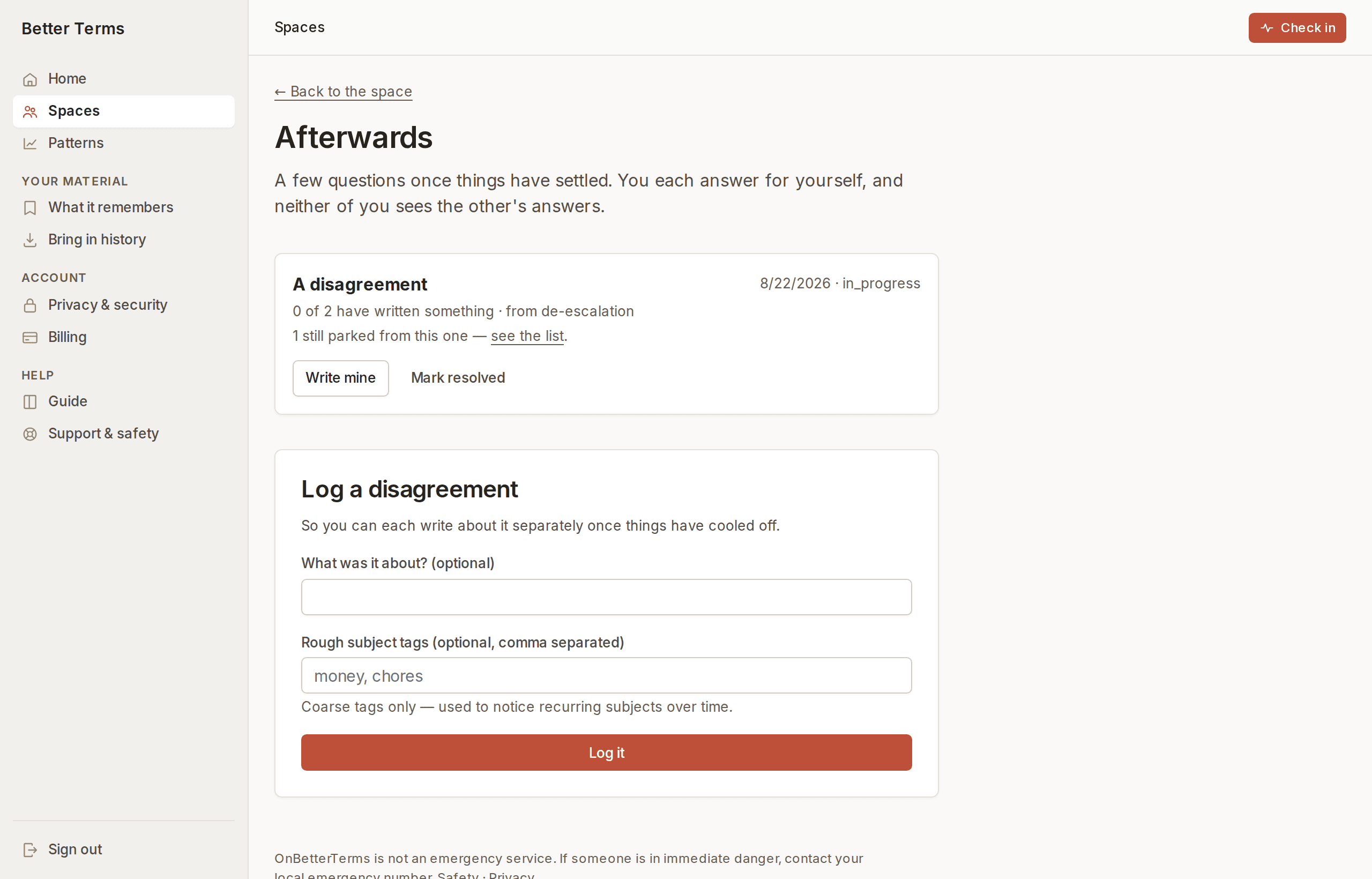
Conflict debriefs
Afterwards, separately: did that get resolved, did you feel heard, is anything still bothering you. Your answers stay private. A shared takeaway needs you both to agree.
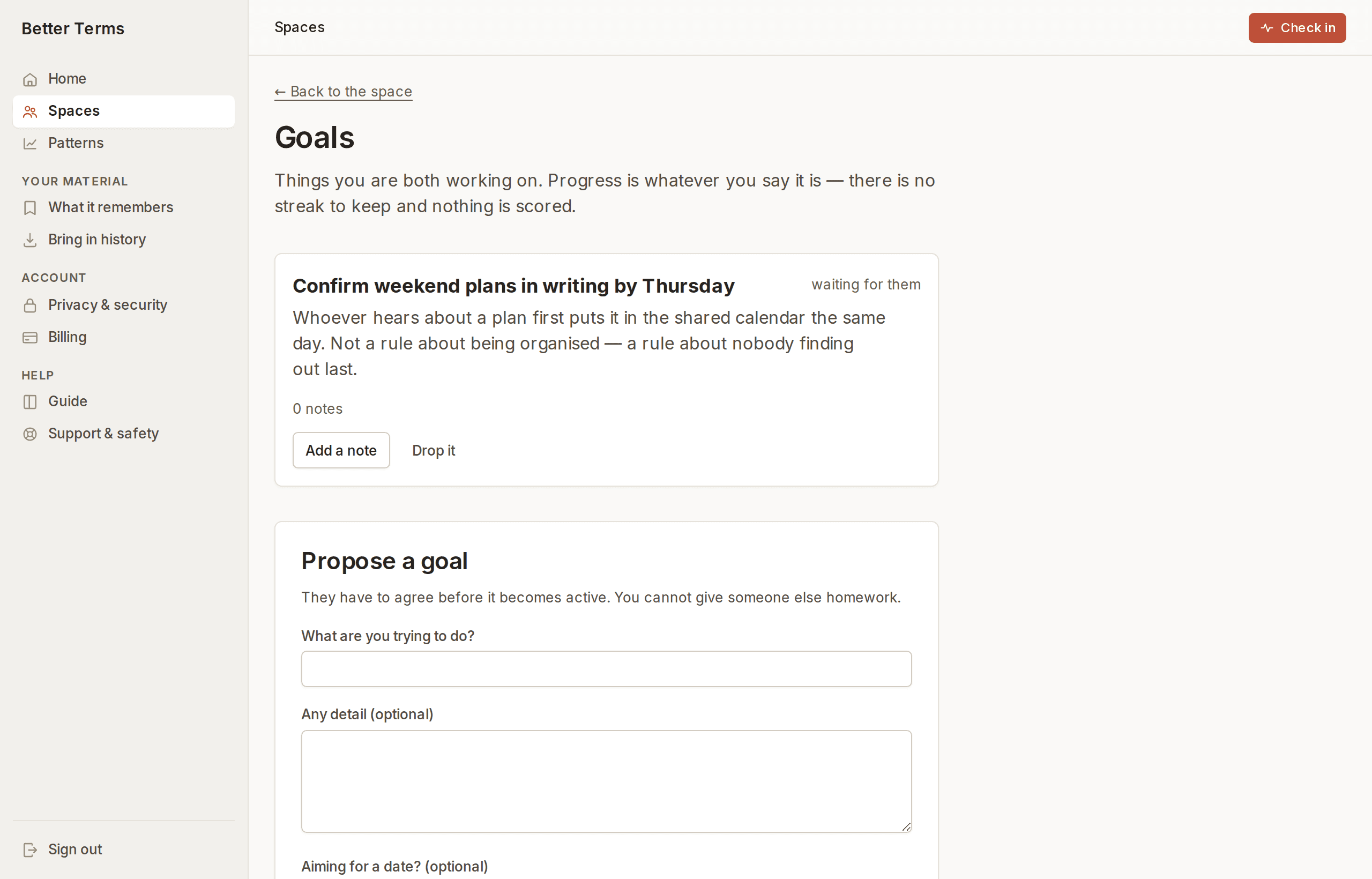
Shared goals
Argue less about money. One evening a week. Stop interrupting. Progress is self-reported and deliberately coarse — no streaks, no scores, no leaderboard.
Appreciation log
Something good happened. They did something that helped. It went better than last time. A record of only the problems is a distorted record.
Over time
Relationship pulse
Fast multi-dimensional check-ins — connection, tension, communication, feeling heard, and more, varying by the kind of relationship. Several a day is normal.
Pattern insights
What keeps coming up, which days are hard, how long it takes to recover after a disagreement, whether things are trending. Always hedged, always linked to the actual evidence.
Predictive signals, optional
Bounded and explainable — "several patterns that have preceded difficult evenings are present today". Never a probability that your relationship will fail. Switch it off entirely if you would rather not.
Control and safety
Safety system
Recognises when this has stopped being a communication problem, surfaces real resources, and stops giving relationship advice where it would be the wrong tool.
Abuse-aware guidance
When signs of control or abuse appear, the app stops suggesting compromise and never notifies the other person that anything changed.
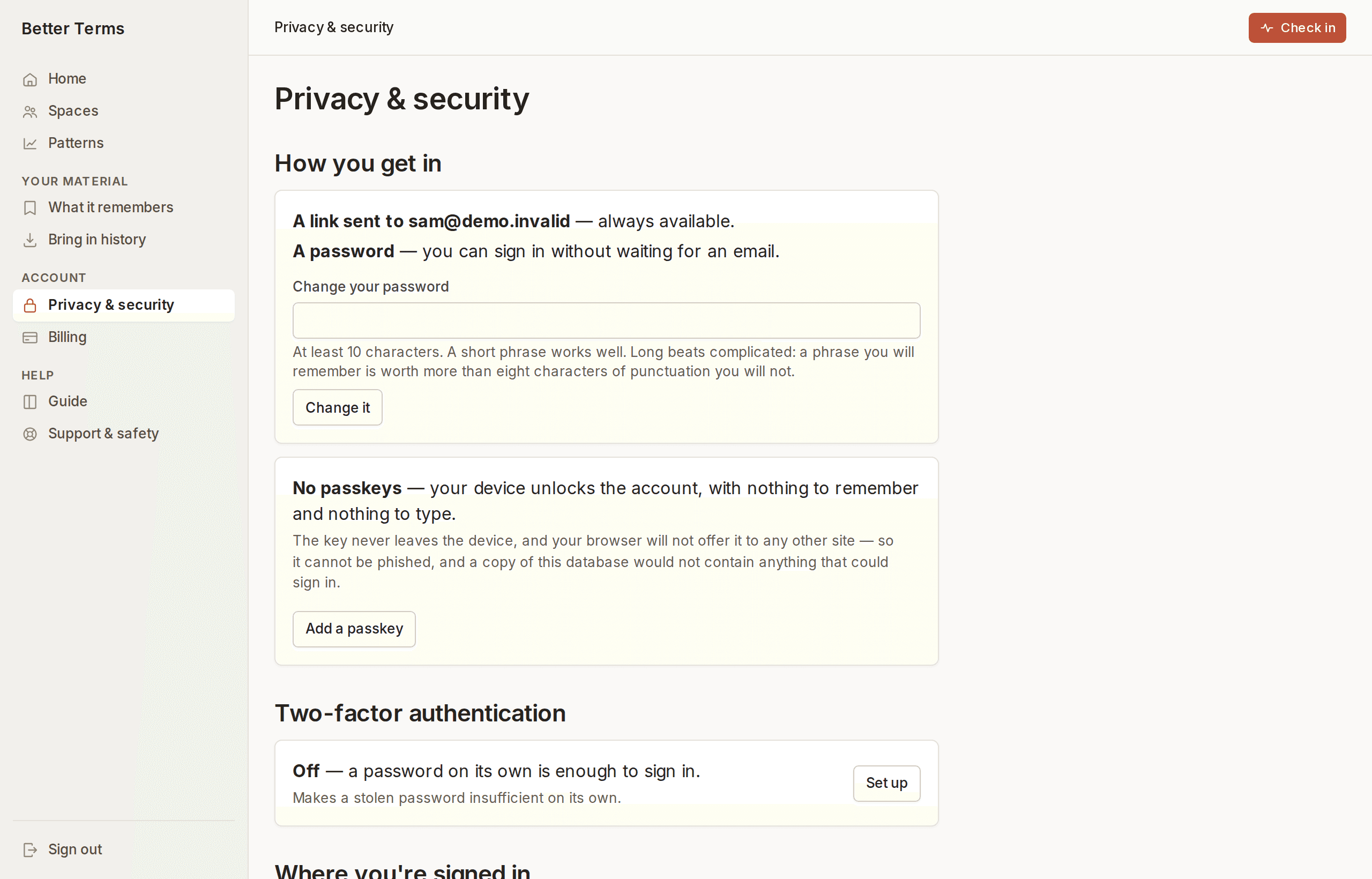
Device and session control
See everywhere you are signed in and sign out of all of them instantly.
Export and delete
Download everything. Delete an entry, your audio, or your whole account. Leaving a shared space destroys nothing you wrote.
Some of it, on screen
Screenshots of the running application with demo content — not mockups.
See it with your own material.
Import an export, or start from nothing. Both work.